
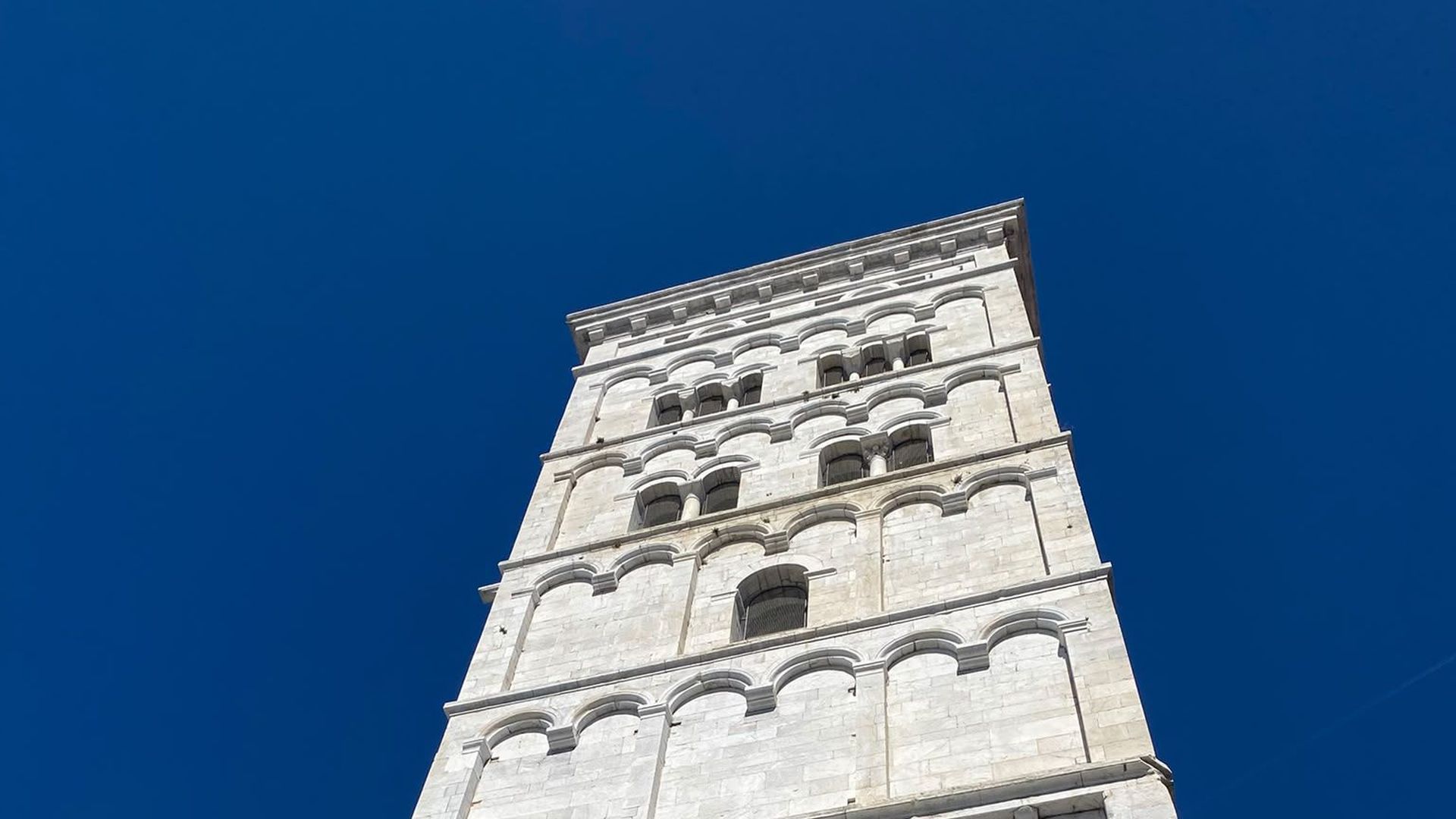
In the city of red roofs, densely packed streets, and rooftop terraces overlooking hidden gardens, the temptation to enjoy a bird's-eye view is great. Lucca offers many opportunities to enjoy a bird's-eye view. A stroll along the Walls of Lucca is a good start, but you can go higher.
From September 29, 2026, the feast of Saint Michael, the bell tower of the church that stands on the ancient Roman forum will also be open to visitors.
San Michele is more than a church. It is the historic political and social hub of the city, not only because it stands on the ancient Forum, but above all because the community has called it to this role century after century.
The basilica's origins date back to the 11th century; the bell tower's presence is first documented in 1170, when it must have had an appearance very similar to its current one, characterized by a series of single-lancet windows that ascend to become double-lancet windows and then triple-lancet windows. We also know that one of the current bells was cast in 1215, followed by three more in 1258 and another in 1273.
The seven bells have also been restored, the ancient bronzes reunited with their original hubs after being separated in the second half of the twentieth century. This also marks the recomposition of a system that for centuries has given voice to the community's time, announcing celebrations, accompanying civil events, and signaling emergencies.
Some drawings and paintings of the medieval city show us a skyline characterised by numerous vertical buildings.
Defense towers, tower houses, palace towers, bell towers.
Many of them are still well integrated into the urban fabric today. Some are accessible, and from the top you can enjoy a beautiful view of the Lucca plain.
They are the elegant tower of Palazzo Guinigi (230 steps), unmistakable with its crown of holm oaks at the top; the municipal clock tower, known as the Torre delle Ore (207 steps), which has kept the "Lucca time" for centuries and which still works today thanks to a precision mechanism dating back to the 18th century, the structure of which is visible inside the tower; and the mighty bell tower of the Cathedral of San Martino (217 steps), crowned by Guelph battlements.
Not far from the Guinigi Tower, right along Via Fillungo, Lucca's main street, is the Torre delle Ore, the city's civic tower since the 14th century. Its distinctive feature is the clock mechanism created in 1752 by Genevan Louis Simon, specifically for the tower in Lucca. Two years later, a new dial was installed, the work of Lucca clockmaker Sigismondo Caturegli, and three new bells were cast by another Lucchese, Stefano Filippi. Climbing the narrow staircase that opens onto the terrace and the city panorama is a unique experience not to be missed during a stay in Lucca.
Then there are the bell towers of the churches, large and mighty,
with Guelph battlements that identify the city's position in the medieval political world, strategically placed near the Walls and used not only as bell towers but also as watchtowers.
The cathedral of Lucca was the first to be made accessible to the public. On the way up, you cross the balcony overlooking the church's central nave and enjoy a spectacular view of the interior, with its Gothic women's galleries and imposing pillars. From the bell tower of the cathedral of San Martino, the gaze sweeps across the southern part of the city, the nearby Piazza Napoleone, the angel of San Michele, and the promenade along the walls of Lucca, beyond which you can glimpse the bold line of the 19th-century aqueduct that runs through the countryside to Monte Pisano.
The most recent opening, however, is that of the bell tower of the Basilica of San Frediano, this time on the north side, but still close to the Walls. From here, the view lingers over the nearby Piazza dell'Anfiteatro, the winding Via Fillungo and the garden of Palazzo Pfanner, the towers of the medieval Borgo delle Mura gate, and finally extends outward to the Serchio River, the hills separating the Lucca plain from Versilia, and beyond, reaching the unmistakable profile of the Apuan Alps.
From the underground to the sky, from its foundation to the present day, this is the experience of visiting the Basilica of San Giovanni.
The Monumental and Archaeological Complex of Saints Giovanni and Reparata houses some of the most important testimonies to Lucca's history, from Roman times to the present day. The site is the result of a major excavation and restoration campaign that began in the late 1970s and concluded with the conversion of the entire complex into a museum in the early 1990s.
Beneath the church of San Giovanni lies one of Lucca's most important archaeological sites, accessible via metal walkways. But after visiting the underground area, be sure to climb the narrow steps of the bell tower, which lead to another panoramic view of the city's rooftops.