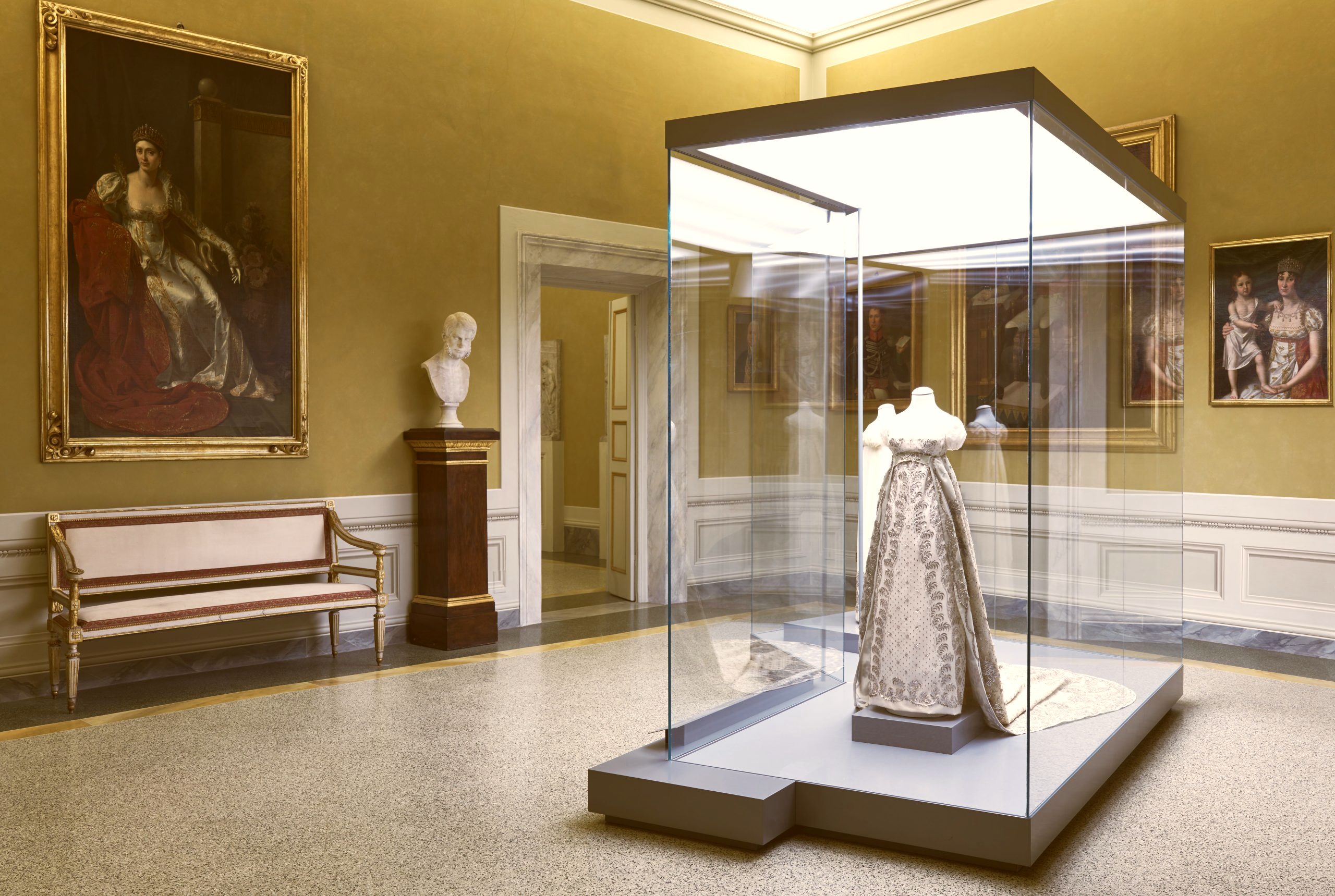
The refined and sumptuous dress, together with the matching cloak,
It is an extremely rare work of art that belonged to Elisa Bonaparte Baciocchi, confirmed by in-depth studies of archival documentation. It also represents an exceptional example of French embroidery art during the First Empire, intended for the dresses of princesses and empresses, as well as a significant testimony to the courtly representation system established in Lucca during Napoleon's rule.
The Ensemble de Court is made of white silk tulle with silver foil embroidery.
The ensemble of ornaments, featuring floral motifs and elegant "feathered" palmettes, typical of the Empire style, establishes a clear stylistic continuity between the cloak and the dress: the embroidery on the dress echoes the motif of the palmette border on the cloak, lending the ensemble a strong, unifying and symbolic character. These ornaments also reveal a clear derivation from the formal language developed for French imperial ceremonies and, in particular, from the designs created by Jean-Baptiste Isabey for the ceremonial robes for Napoleon Bonaparte's coronation in Paris in 1804.
Elisa regularly bought her clothes in France,
according to the economic policy promoted by Napoleon to support the national textile industries, as evidenced by the correspondence of the Countess de Laplace, his lady-in-waiting.
This Ensemble de Court is closely linked to the period in which Elisa ruled the Principality of Lucca and Piombino (1805–1814), when the city became the seat of a court modelled on the French imperial one.
It should also be noted that it was the same painters and architects active at Napoleon's court who provided the imperial factories with the preparatory cartoons for these precious embroideries, including Pierre-François-Léonard Fontaine and Charles Percier. This allows the dress and cloak to be placed in the Hall of the Princes of Palazzo Mansi, within the Neoclassical section, as they too are an expression of the artistic culture and formal language of the First Empire.